AI agents aren't science fiction anymore. According to Gartner's August 2025 report, 40% of new enterprise applications shipped with at least one AI agent embedded—up from virtually zero just two years ago. The global AI agent market reached $7.6 to $7.8 billion in 2025, with projections to exceed $50 billion by 2030. Yet most people still can't articulate what an AI agent actually does differently from a chatbot. This guide breaks down everything you need to know: from core concepts to real-world deployments transforming industries today.
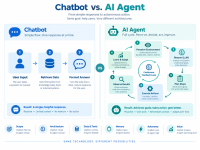
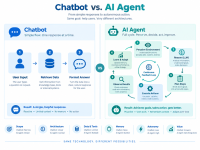
An AI agent is a software system that autonomously perceives its environment, reasons about available options using foundation models, plans multi-step workflows, executes actions through APIs and tools, and learns from feedback to achieve predetermined goals. According to Gartner's June 2025 report, 52% of enterprises have already implemented AI agents in core functions, with 35% more planning deployment by 2027. The key differentiator: chatbots are read-only systems that respond to user input; agents are read-write-act systems that modify external systems without requiring human approval for every step.
This autonomy is the defining characteristic. An agent sees a problem, breaks it into steps, tries approaches, observes results, and adjusts course. Chatbots don't do that. They generate text based on patterns. Agents actively shape their environments through API calls, database updates, and tool usage.
[Image: Flowchart comparing chatbot vs AI agent architectures]
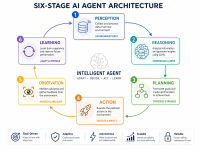
[Image: AI Agent Architecture Pipeline showing the 6-component cycle]
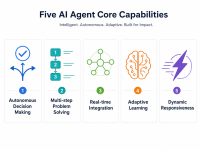 Modern AI agents demonstrate five core capabilities that distinguish them from older automation technologies. According to PwC's 2026 survey, 79% of companies claim active AI agent adoption, with 88% of executives planning to increase budgets. This growth reflects confidence in agent capabilities.
The impact on healthcare efficiency is dramatic. Claims processing that previously took 15-16 days now completes in 1-2 days when AI agents handle document review, initial triage, and validation (Gartner, June 2025).
BNY Mellon's Eliza agent handles 125+ live use cases across 20,000 employees, automating routine inquiries and data retrieval.
[Image: Industry showcase with healthcare, finance, supply chain, support, developer, and operations use cases]
Key Insight: Chatbots excel at answering questions. RPA excels at repeating tasks when rules are clear. AI agents excel when situations are complex, novel, or require reasoning—which is why enterprise adoption accelerated so sharply in 2025-2026.
About 40% of agentic AI projects face cancellation risk by 2027 without proper governance frameworks (Gartner, 2025). This risk reflects implementation challenges, not technical limitations.
The numbers are striking. Eighty percent of enterprise applications in Q1 2026 embed at least one AI agent. The global market reached $7.6-$7.8 billion in 2025, with projections exceeding $50 billion by 2030. Sixty-one percent of enterprise AI deployments now involve multi-agent architectures, up from 23% just two years prior. This acceleration reflects confidence: organizations see measurable results.
What makes this moment different from previous automation waves is the reasoning capability. Legacy systems execute prescriptive rules. AI agents reason about novel situations, handle exceptions, and improve through experience. Healthcare claims processing dropped from 15-16 days to 1-2 days. Code review cycles dropped from 3 hours to 1 hour. Customer support agents handle 70%+ of issues without human escalation.
If you're in a technology leadership role, the question isn't whether to adopt AI agents—it's how fast to move and where to focus first. Start with clear problems, implement governance from day one, and measure outcomes rigorously. The organizations moving fastest today will have built the institutional knowledge to deploy at scale by 2027.
For anyone building software or managing processes, understanding AI agents is becoming essential literacy. You don't need to build them yourself, but you should understand what they're capable of, where they fit in your architecture, and how to evaluate solutions from vendors.
The next few years will clarify which agent capabilities stick, which governance approaches work, and which implementation patterns succeed. The foundation is solid. The momentum is real. The era of autonomous, reasoning systems handling complex workflows is here.
Key Takeaways
- AI agents autonomously perceive, reason, and take actions without human approval at every step (unlike chatbots, which respond to queries)
- 80% of enterprise applications in Q1 2026 embed at least one AI agent (PwC, 2026)
- The market grew from $7.6B in 2025 to a projected $50B+ by 2030
- Real-world deployments cut healthcare claims processing from 15-16 days to 1-2 days
- Multi-agent architectures now power 61% of enterprise AI deployments (up from 23% in 2024)
What Are AI Agents? Definition and Core Concepts
How AI Agents Differ from Chatbots
Chatbots operate within a simple input-output loop. You ask a question; they retrieve and format an answer from training data or a knowledge base. AI agents work fundamentally differently. They can access external tools, make decisions based on outcomes, and iterate until achieving a goal. A customer service agent might handle a refund request by checking inventory, verifying purchase history, confirming customer eligibility, and processing the transaction—all without human intervention at each stage.This autonomy is the defining characteristic. An agent sees a problem, breaks it into steps, tries approaches, observes results, and adjusts course. Chatbots don't do that. They generate text based on patterns. Agents actively shape their environments through API calls, database updates, and tool usage.
The Autonomy Spectrum
Not all autonomous systems are equal. A simple rule-based workflow (if invoice is overdue → send reminder) doesn't have agency. A modern AI agent using large language models combined with planning modules does. The spectrum ranges from static chatbots to fully autonomous systems making complex, multi-step decisions in dynamic environments. Most 2025-2026 deployments sit in the middle: guided autonomy where agents handle routine tasks but escalate edge cases.[Image: Flowchart comparing chatbot vs AI agent architectures]
Core Components: How AI Agents Actually Work
The architecture of a working AI agent involves six interconnected systems that operate together seamlessly. According to IDC, 60% of enterprise AI workflows will rely on multi-agent coordination by 2028, up from current deployments where individual agents handle isolated tasks. Understanding these components explains why agents are more powerful than traditional automation.1. Perception Layer: Understanding the World
An AI agent's perception begins with sensor data or system inputs. In customer support, that might be a support ticket with customer account information. In healthcare, it's patient records and clinical notes. In supply chain, it's real-time inventory levels and demand forecasts. The perception layer transforms raw inputs into structured data the reasoning engine can process.2. Reasoning Engine: The LLM Core
The reasoning engine is typically a large language model (LLM) like GPT-4, Claude, or similar foundation models. This component evaluates the perceived situation against the agent's goals and available tools. It decides what action best moves toward the objective given current constraints.3. Planning Module: Breaking Problems into Steps
Complex goals require multi-step solutions. A planning module decomposes high-level objectives into actionable tasks. If the goal is "process this customer return," the plan might be: (1) verify return eligibility, (2) arrange logistics, (3) update inventory, (4) process refund, (5) send confirmation. The planning module creates this sequence, which the action layer then executes.4. Tools and API Integration
An agent without tools is powerless. Tools are APIs, databases, and external services that agents can call to take action. A customer support agent might have access to order management APIs, customer database queries, shipping provider integrations, refund processing systems, and email services. Without these tools, even perfect reasoning leads nowhere.5. Knowledge Base and Memory
AI agents operate in specific contexts. A customer support agent needs to remember customer preferences, previous issues, and loyalty status. This information lives in three layers of memory:- Short-term memory: Current conversation or task session
- Medium-term memory: Recent history (previous interactions this year)
- Long-term memory: Persistent knowledge (preferences, account standing)
6. Observability and Feedback
Agents improve through feedback. Unlike traditional software that follows static rules, agents can learn that certain approaches work better than others in specific contexts. This feedback loop requires observability: logging every decision, action, and outcome.[Image: AI Agent Architecture Pipeline showing the 6-component cycle]
What Can AI Agents Do? Capabilities and Behaviors
Autonomous Decision-Making
Agents make choices without waiting for human approval. They evaluate options against objectives and execute decisions within their authorized parameters. A warehouse agent deciding between multiple shipping methods bases the decision on cost, delivery speed, and customer preferences; no human needed for approval.Multi-Step Problem Solving
Complex problems rarely solve in one step. An AI agent booking a business trip must check calendar availability, search flights and hotels, compare costs against budget, coordinate with team members' schedules, and complete the booking. Each step depends on previous results. Agents handle this dependency chain naturally.Real-Time Integration with External Systems
Agents don't just talk about your systems; they integrate with them. They read from databases, write to applications, trigger workflows, and coordinate across platforms. A financial agent can query transaction histories, calculate tax implications, update ledgers, and generate reports in a single workflow.Adaptive Learning
Unlike static rule systems, agents learn from outcomes. When approaches succeed, agents can generalize that learning. When failures occur, agents can adjust strategy or flag issues for human review. Over time, an agent handling customer disputes becomes progressively better at understanding which resolution paths work for different customer segments.Real-Time Responsiveness to New Information
Agents operate in dynamic environments where conditions change constantly. When a stock level changes mid-transaction, agents adjust recommendations. When a supplier confirms unexpected delays, agents proactively reschedule. They don't require scheduled batch processing or human intervention to stay current.Real-World Examples: AI Agents Transforming Industries
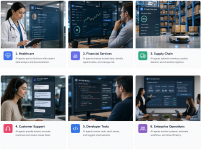
The theoretical capabilities matter only because they deliver measurable results. Six industries are seeing AI agents reshape workflows today.Healthcare: From Days to Hours
Kaiser Permanente partnered with Abridge to deploy ambient documentation AI agents across 40 hospitals and 600+ offices. This represents the largest generative AI healthcare rollout to date. Agents listen during patient-clinician conversations, generate documentation notes automatically, and reduce administrative burden.The impact on healthcare efficiency is dramatic. Claims processing that previously took 15-16 days now completes in 1-2 days when AI agents handle document review, initial triage, and validation (Gartner, June 2025).
Financial Services: From Manual to Automated
JPMorgan deployed AI agents across 450+ use cases impacting 200,000 employees. Tasks range from regulatory compliance checks to complex trade analysis. The bank estimates annual savings in the tens of millions through reduced processing time and improved accuracy.BNY Mellon's Eliza agent handles 125+ live use cases across 20,000 employees, automating routine inquiries and data retrieval.
Supply Chain and Logistics: Optimizing Movement
Autonomous dispatching agents optimize delivery routes, manage fleet utilization, and coordinate logistics across complex networks. These agents process real-time traffic data, vehicle availability, package priorities, and cost constraints to make routing decisions faster than human planners.Customer Support: Handling the Majority
AI customer support agents now handle 70% or more of first-contact queries without human escalation. Tier 1 support—the high-volume, repetitive requests—is automated completely. Agents handle returns, billing questions, technical troubleshooting, and account management.Developer Productivity: Speeding Code Workflows
Duolingo deployed AI agents to optimize code review workflows. Previously, a code review took 3 hours end-to-end. With AI agent assistance, the same review now completes in 1 hour. The agent handles rote checking; humans focus on architectural decisions.[Image: Industry showcase with healthcare, finance, supply chain, support, developer, and operations use cases]
AI Agents vs. Other Technologies: What Makes Them Different?
The market includes multiple automation technologies. Understanding how AI agents compare clarifies when each approach fits best.| Capability | AI Agents | Chatbots | RPA | Rules-Based |
|---|---|---|---|---|
| Autonomy | High: Acts without approval | None: Responds to input | High: Executes tasks | None: Requires triggers |
| Learning | Yes: From feedback | Limited: No mechanism | No: Follows scripts | No: Static rules |
| Reasoning | Yes: LLM-based | No: Pattern matching | No: Rules-based logic | No: Conditional |
| Multi-step Workflows | Yes: Naturally | No: Not designed | Yes: But rigid | Yes: But inflexible |
| Handle Exceptions | Yes: Reason through | No: Escalate | No: Need new rules | No: Escalate |
| Implementation Time | Weeks | Days | Months | Weeks |
About 40% of agentic AI projects face cancellation risk by 2027 without proper governance frameworks (Gartner, 2025). This risk reflects implementation challenges, not technical limitations.
How to Get Started with AI Agents
Building your first AI agent doesn't require a PhD in machine learning. Modern platforms abstract away complexity significantly.Start with a Clear Problem
Define the specific task your agent solves. "Automate customer returns processing" beats "build an intelligent agent." Clear scope ensures you can measure success: Did claims processing time drop? Is human escalation rate acceptable?Choose Your Foundation
You have three architectural choices:- Build on open-source frameworks (LangChain, AutoGPT)
- Use cloud platform tools (AWS Bedrock, Google Cloud Agents)
- Leverage specialized platforms (DevRev Automation, AutoGPT Enterprise)
Identify Available Tools and APIs
List all systems your agent must access: databases, payment processors, communication platforms, inventory systems. Each system needs an API integration. Good tool documentation is critical.Start Small and Iterate
Your first agent should solve one problem narrowly. Deploy it with humans in the loop: agents suggest actions, humans approve before execution. Successful first deployments often focus on high-volume, low-risk processes: processing routine tickets, categorizing incoming documents, extracting data from forms.Implement Governance and Monitoring
As agents take action in production systems, governance becomes essential. You need:- Action audit logs: Every decision and action recorded
- Escalation protocols: Clear criteria for human review
- Error budgets: Acceptable failure rates per task type
- Update processes: How to retrain or adjust behavior
- Compliance checks: Ensuring actions meet regulatory requirements
The Future of AI Agents: What's Coming
AI agent technology is evolving rapidly. Several trends will shape the next two years.Increased Autonomy and Complexity
Current agents handle specialized tasks. Future agents will coordinate across multiple domains. According to IDC research, 60% of enterprise AI workflows will rely on multi-agent coordination by 2028. This represents a fundamental architecture shift.Improved Reliability and Governance
Current limitations around hallucinations, error handling, and governance are being addressed. Future agents will have better uncertainty quantification, more robust error recovery, and built-in compliance checking.Cost Efficiency
Large language models are becoming dramatically cheaper. Today, deploying enterprise-grade agents is costly. Within two years, costs will drop by 5-10x, enabling deployment across smaller organizations and lower-value processes.Specialized Agent Architectures
Generic agents work well for broad tasks, but specialized architectures are emerging for specific domains. Healthcare agents built with clinical knowledge embedded, financial agents with regulatory guardrails, supply chain agents with logistics domain expertise.Human-Agent Collaboration Patterns
Rather than full autonomy, the most productive approach is humans and agents as collaborative partners. Agents handle routine processing; humans provide judgment and exceptions. This hybrid model combines agent efficiency with human reliability.Frequently Asked Questions About AI Agents
What's the difference between AI agents and chatbots?
Chatbots respond to user queries using text generation. They're read-only: they provide information but don't modify systems. AI agents are read-write-act systems that autonomously perceive environments, make decisions, and take actions through APIs and tools without requiring human approval for every step. A chatbot answers "What's my account balance?" An agent handles "Refund this order"—detecting the issue, verifying eligibility, processing the refund, and confirming with the customer (Gartner, August 2025).How do AI agents learn and improve over time?
Agents improve through feedback loops. Every action generates results that can be monitored. Successful outcomes reinforce effective strategies; failures prompt adjustment. Unlike traditional software with static rules, agents can generalize from specific interactions to broader patterns. This learning occurs through prompt engineering updates, fine-tuning training data, and behavioral feedback mechanisms.Can AI agents operate without human oversight?
In principle yes; in practice, most enterprise deployments include governance guardrails. Agents have "action budgets": they can approve refunds under $100 autonomously but escalate larger disputes. The hybrid model—agents handling routine decisions, humans handling exceptions—is current best practice. As technology matures and trust builds, autonomy increases.What are the main risks and governance challenges?
The primary risks are hallucinations (agents confidently providing incorrect information), tool misuse, bias, and unintended consequences. Mitigating these requires: audit logging, human oversight protocols, error monitoring, compliance checking, and clear escalation criteria. Organizations implementing strong governance see better outcomes.How much does it cost to build an enterprise AI agent?
Cost varies dramatically by scope. A simple agent automating one workflow: $50K-$150K. A full-featured agent handling multiple processes: $500K-$2M+. Cloud platforms charge based on API calls and language model tokens. A high-volume customer support agent might cost $200-$500 per month in cloud expenses plus initial development. ROI typically appears within 6-12 months.What industries are seeing the most AI agent adoption?
Financial services leads adoption. JPMorgan, BNY Mellon, and major banks deployed hundreds of agents. Healthcare follows: Kaiser Permanente's ambient documentation rollout is the largest healthcare AI deployment to date. Customer support is third: 70%+ of first-contact queries in leading companies now handled by agents. Within two years, adoption will broaden across industries as cost decreases.Conclusion: Why AI Agents Matter Now
AI agents represent a fundamental shift in how software addresses complex problems. Rather than following rigid rules or requiring human intervention at each step, agents perceive situations, reason about options, plan multi-step solutions, execute actions, and learn from results. This capability is no longer theoretical; it's production reality across Fortune 500 companies.The numbers are striking. Eighty percent of enterprise applications in Q1 2026 embed at least one AI agent. The global market reached $7.6-$7.8 billion in 2025, with projections exceeding $50 billion by 2030. Sixty-one percent of enterprise AI deployments now involve multi-agent architectures, up from 23% just two years prior. This acceleration reflects confidence: organizations see measurable results.
What makes this moment different from previous automation waves is the reasoning capability. Legacy systems execute prescriptive rules. AI agents reason about novel situations, handle exceptions, and improve through experience. Healthcare claims processing dropped from 15-16 days to 1-2 days. Code review cycles dropped from 3 hours to 1 hour. Customer support agents handle 70%+ of issues without human escalation.
If you're in a technology leadership role, the question isn't whether to adopt AI agents—it's how fast to move and where to focus first. Start with clear problems, implement governance from day one, and measure outcomes rigorously. The organizations moving fastest today will have built the institutional knowledge to deploy at scale by 2027.
For anyone building software or managing processes, understanding AI agents is becoming essential literacy. You don't need to build them yourself, but you should understand what they're capable of, where they fit in your architecture, and how to evaluate solutions from vendors.
The next few years will clarify which agent capabilities stick, which governance approaches work, and which implementation patterns succeed. The foundation is solid. The momentum is real. The era of autonomous, reasoning systems handling complex workflows is here.